> For the complete documentation index, see [llms.txt](https://stephen-tsoi.gitbook.io/stephen-tsoi-docs/llms.txt). Markdown versions of documentation pages are available by appending `.md` to page URLs; this page is available as [Markdown](https://stephen-tsoi.gitbook.io/stephen-tsoi-docs/event-driven-architecture/self-service-vs.-event-driven-architecture-finding-the-right-balance.md).
# 🚦Self-Service vs. Event-Driven Architecture: Finding the Right Balance
A practical guide to balancing developer autonomy with enterprise stability, proposing a hybrid self-service model that accelerates lower environments while securing production.
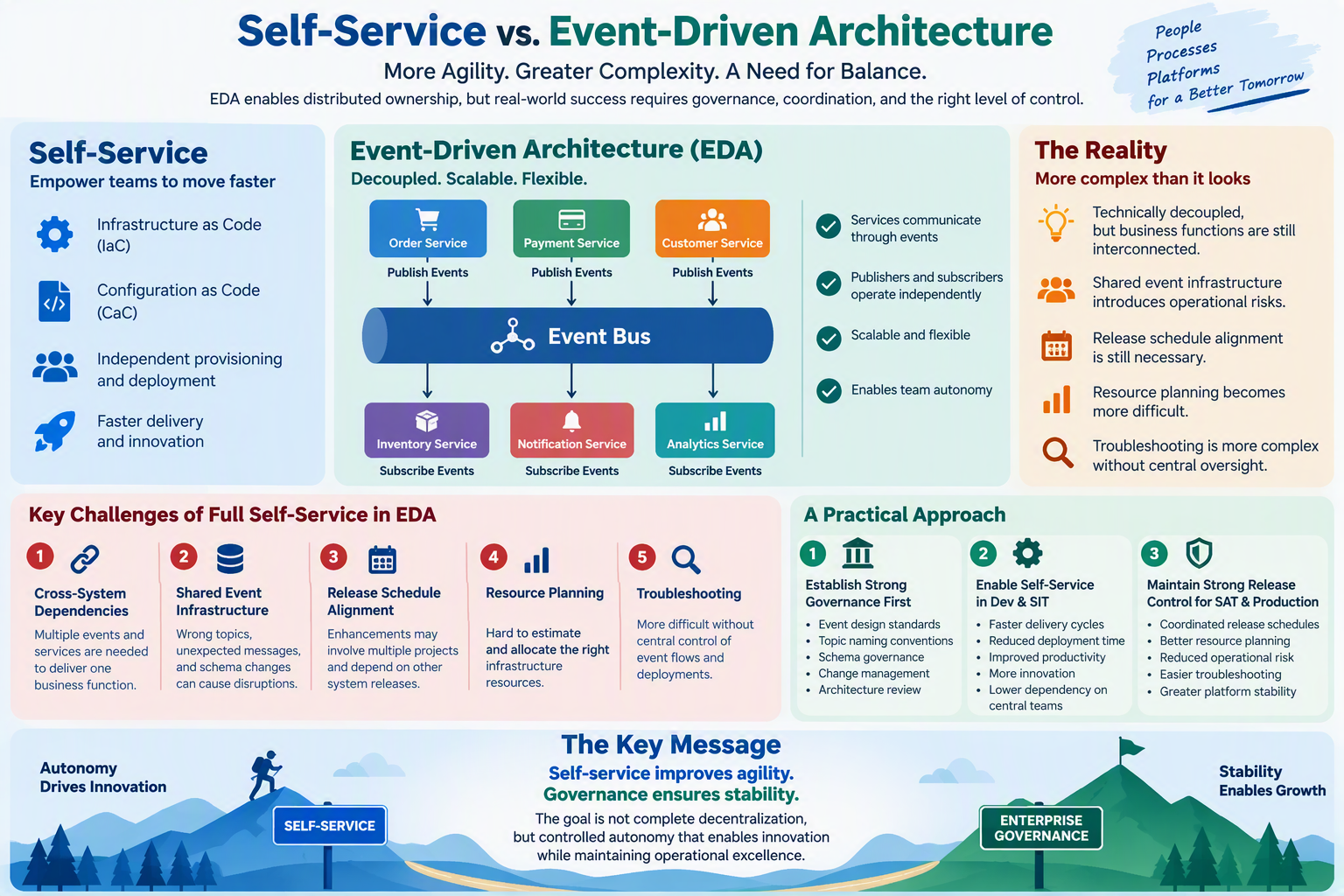
As enterprise architecture continues to evolve, system landscapes are becoming increasingly complex, with more applications and services being onboarded every year. To improve agility and reduce operational bottlenecks, organizations are embracing self-service capabilities. Infrastructure as Code (IaC) and Configuration as Code (CaC) are common examples of this trend, enabling teams to provision and manage resources independently.
At first glance, Event-Driven Architecture (EDA) appears to be an ideal foundation for self-service. EDA promotes a distributed design in which services communicate through events, allowing publishers and subscribers to operate independently through an event bus. This architectural style offers scalability, flexibility, and team autonomy.
However, the reality is often more complex than the theory suggests.
***
🎯 The Promise of Self-Service in EDA
In a typical EDA platform:
📤 Services publish events without knowing who consumes them.
📥 Services subscribe to events without direct integration with publishers.
🔄 Teams can develop and deploy independently.
⚡ Business capabilities can be extended through new consumers without modifying existing producers.
From an architectural perspective, this seems to perfectly align with the vision of self-service and decentralized ownership.
Yet enterprise-scale implementations reveal a different set of challenges.
⚠️ Challenges of Applying Full Self-Service in EDA
🔗 1. Business Functions Still Create Cross-System Dependencies
Although EDA enables loose coupling at the technical level, many business functions require multiple events and services to work together across different systems.
For example, a customer onboarding process may involve:
* Customer Management System
* Identity Verification Service
* Notification Service
* CRM Platform
* Reporting Platform
Each component may be technically independent, but they collectively deliver a single business capability.
As a result, project enhancements still require coordination across multiple teams and systems.
The architecture may be distributed, but business delivery remains interconnected.
📡 2. Shared Event Infrastructure Creates Operational Risks
Most organizations share one or more messaging infrastructures, such as:
* Event brokers
* Messaging VPNs
* Event meshes
* Enterprise event buses
Issues can occur when:
❌ A publisher sends messages to the wrong topic.
❌ A subscriber subscribes to an unintended topic.
❌ Event schemas are modified without proper coordination.
❌ Routing configurations are changed incorrectly.
In these situations, downstream systems may receive unexpected events, potentially resulting in service disruptions, processing failures, or data inconsistencies.
While services appear autonomous, they are still connected through a shared communication fabric.
📅 3. Release Schedule Alignment Remains Necessary
A common misconception is that EDA completely eliminates release dependencies.
In reality:
* One system enhancement may support multiple projects.
* Event schema changes may require consumer upgrades.
* New business functions often involve changes across several services.
* Different systems may follow different release calendars.
As a result, deployment timing must still be coordinated to ensure end-to-end business functionality.
Technical decoupling does not automatically remove operational dependency.
📊 4. Resource Planning Becomes More Difficult
If every system team can independently deploy event-bus changes, platform teams may struggle to:
* Forecast event volume growth
* Allocate broker capacity
* Manage infrastructure resources
* Maintain platform performance
Without centralized visibility, resource consumption can grow unpredictably.
The challenge becomes even more significant when multiple projects launch simultaneously and introduce competing demands on the shared messaging infrastructure.
🔍 5. Troubleshooting Is More Complex
Troubleshooting in a distributed event-driven environment is significantly harder than in traditional centralized systems.
Operations teams need visibility into:
* Event flows
* Topic subscriptions
* Routing paths
* Event schemas
* Deployment history
* Cross-system dependencies
Without central oversight, identifying the root cause of an incident can become a lengthy and complex investigation involving multiple teams.
The greater the autonomy, the greater the need for observability and governance.
✅ A Practical Approach to Self-Service in EDA
Self-service and EDA are not mutually exclusive. In fact, they can complement each other very effectively when implemented with the appropriate controls.
🏛️ 1. Establish Strong Governance First
Before enabling self-service, organizations should implement:
✅ Event design standards
✅ Topic naming conventions
✅ Schema governance
✅ Change approval processes
✅ Architecture review procedures
✅ Service ownership models
✅ Operational support guidelines
Strong governance helps prevent uncontrolled growth while maintaining platform stability.
***
🧪 2. Enable Self-Service in Development and SIT Environments
Self-service deployment can provide significant benefits in non-production environments.
Benefits include:
⚡ Faster development cycles
⚡ Reduced deployment lead time
⚡ Improved developer productivity
⚡ Increased innovation and experimentation
⚡ Reduced dependency on central platform teams
Development and SIT environments are ideal places for teams to move quickly and validate their solutions.
***
🛡️ Production Still Requires Strong Release Control
For SAT, UAT, and Production environments, strong release governance remains critical.
A centralized release process provides:
✅ Better management of cross-system dependencies
✅ Coordinated deployment schedules
✅ Improved capacity planning
✅ Reduced operational risk
✅ Easier troubleshooting and incident management
✅ Greater platform stability
A centralized deployment model also provides flexibility when production release schedules change. Event bus configurations, topic permissions, routing policies, and other platform-level settings can be managed in a controlled and coordinated manner.
💡 Final Thoughts
Event-Driven Architecture is often viewed as a natural enabler of self-service because it promotes decentralization and allows teams to develop and operate services independently. However, independence at the technical component level does not eliminate dependencies at the business, operational, and release-management levels.
In large enterprise environments, shared event infrastructure, cross-system business processes, release dependencies, resource planning, and production support requirements still require centralized governance and coordination. Without proper controls, excessive decentralization can introduce operational risks, service instability, and increased troubleshooting complexity.
The objective should therefore not be to pursue self-service at all costs, but to strike the right balance between team autonomy and enterprise governance.
🎯 Recommended Model
🔹 Self-service for Development and SIT environments
🔹 Strong governance throughout the entire lifecycle
🔹 Centralized release and deployment control for SAT, UAT, and Production
🔹 Enterprise-wide visibility of event flows, dependencies, and resource consumption
🚦 The Key Message
EDA enables distributed ownership, but it does not eliminate enterprise responsibility.
Self-service improves agility. Governance ensures stability.
The goal is not complete decentralization, but controlled autonomy that enables innovation while maintaining operational excellence.
---
# Agent Instructions
This documentation is published with GitBook. GitBook is the documentation platform designed so that both humans and AI agents can read, navigate, and reason over technical content effectively. Learn more at gitbook.com.
## Querying This Documentation
If you need additional information that is not directly available in this page, you can query the documentation dynamically by asking a question.
Perform an HTTP GET request on the current page URL with the `ask` query parameter, and the optional `goal` query parameter:
```
GET https://stephen-tsoi.gitbook.io/stephen-tsoi-docs/event-driven-architecture/self-service-vs.-event-driven-architecture-finding-the-right-balance.md?ask=&goal=
```
`ask` is the immediate question: it should be specific, self-contained, and written in natural language.
`goal` is optional and describes the broader end goal you are ultimately trying to accomplish on behalf of the user. GitBook uses it to tailor the answer towards what is most useful for that goal.
The response will contain a direct answer to the question and relevant excerpts and sources from the documentation.
Use this mechanism when the answer is not explicitly present in the current page, you need clarification or additional context, or you want to retrieve related documentation sections.