> For the complete documentation index, see [llms.txt](https://stephen-tsoi.gitbook.io/stephen-tsoi-docs/llms.txt). Markdown versions of documentation pages are available by appending `.md` to page URLs; this page is available as [Markdown](https://stephen-tsoi.gitbook.io/stephen-tsoi-docs/event-driven-architecture/event-mesh-and-cdc-building-a-real-time-data-distribution-platform.md).
# 🚀 Event Mesh and CDC: Building a Real-Time Data Distribution Platform
A practical framework on combining Change Data Capture (CDC) with an Event Mesh to convert raw database transactions into highly reusable, cross-cloud real-time business events.
Data has become one of the most valuable assets in modern enterprises. As organizations adopt multi-cloud architectures and distributed applications, keeping data synchronized across systems has become increasingly challenging.
One of the most common approaches is Change Data Capture (CDC).
📌 What is CDC?
Change Data Capture (CDC) captures database changes, such as:
✅ Insertions
✅ Updates
✅ Deletions
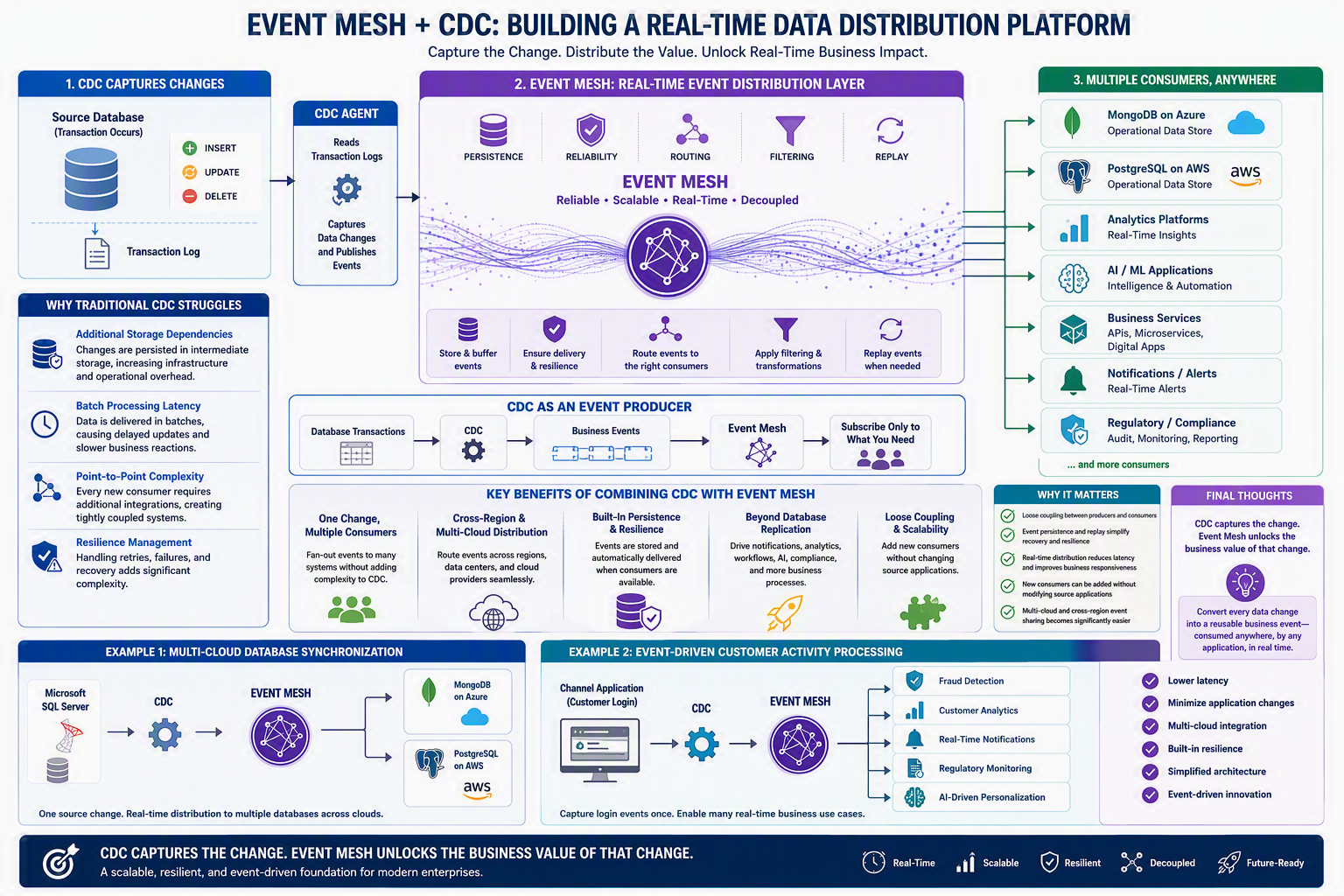
A CDC agent continuously reads database transaction logs and publishes change events, allowing downstream applications and databases to synchronize updates in near real time.
This approach enables near real-time synchronization between applications while minimizing the impact on source systems.
⚠️ Why Traditional CDC Architectures Struggle at Scale
🔸 Additional Storage Dependencies – Changes are often persisted in intermediate files, databases, or staging tables before being delivered, increasing infrastructure and operational overhead.
🔸 Batch Processing Latency – Data is commonly delivered in batches, resulting in delayed updates and slower business reactions.
🔸 Point-to-Point Complexity – Every new consumer requires additional integrations, creating tightly coupled systems that are difficult to scale.
🔸 Resilience Management – CDC platforms must handle retries, failures, and recovery scenarios, adding significant complexity to the overall solution.
🌐 How Event Mesh Enhances CDC Architecture
An Event Mesh provides a real-time event distribution layer between CDC producers and consumers. Rather than creating direct integrations between source and target systems, CDC events are published once into the Event Mesh, which takes responsibility for event routing, delivery, persistence, and distribution across the enterprise.
♻️CDC Challenges
🔸 Limited Consumer Reuse
Traditional CDC architectures often duplicate data streams for every new target system. As the number of consumers grows, operational complexity increases significantly.
🔸 Business Event Visibility
Database changes are captured as technical records rather than business events, making it difficult to build real-time event-driven applications directly from CDC streams.
🔄 CDC as an Event Producer
Traditionally, CDC has been viewed as a data integration technology. In an event-driven enterprise, CDC becomes an event producer that transforms database transactions into business events. Consumers can subscribe only to the events they require, enabling intelligent filtering and routing without increasing complexity in the CDC platform.
🚀 Key Benefits of Combining CDC with Event Mesh
📢One Change, Multiple Consumers\
A single database change can be distributed to multiple downstream consumers simultaneously, including MongoDB on Azure, PostgreSQL on AWS, analytics platforms, AI/ML applications, and business services. This enables scalable fan-out architectures without increasing CDC complexity.
🌍 Cross-Region and Multi-Cloud Distribution\
Event Mesh can intelligently route events across regions, data centers, and cloud providers, enabling seamless data synchronization and event distribution in hybrid and multi-cloud environments.
💾 Built-In Persistence and Resilience\
When a consumer becomes unavailable, events are safely persisted within the Event Mesh and automatically delivered once connectivity is restored. This removes the need for CDC agents to implement custom retry, buffering, and recovery mechanisms.
⚡ Beyond Database Replication\
Database changes are more than records that need to be synchronized. They are business events that can drive notifications, analytics, workflow automation, AI processing, regulatory monitoring, and other event-driven business processes. Event Mesh transforms CDC from a simple replication mechanism into a foundation for enterprise-wide event-driven architecture.
🎯 Why It Matters
✅ Loose coupling between producers and consumers
✅ Event persistence and replay simplify recovery and resilience
✅ Real-time distribution reduces latency and improves business responsiveness
✅ New consumers can be added without modifying source applications
✅ Multi-cloud and cross-region event sharing becomes significantly easier
🏗️ Example 1: Multi-Cloud Database Synchronization
Scenario
A source Microsoft SQL Server database generates change events.
The CDC process publishes these changes into the Event Mesh.
The Event Mesh then simultaneously distributes updates to:
☁️ MongoDB hosted on Microsoft Azure
☁️ PostgreSQL hosted on Amazon Web Services (AWS)
🏗️ Example 2: Event-Driven Customer Activity Processing
Scenario
A channel application automatically records customer login activities, including timestamps and access information.
Only selected data elements are required by downstream services.
Instead of developing multiple direct integrations:
1. CDC captures the login records.
2. Events are published to the Event Mesh.
3. Different backend services independently consume the same login event for fraud detection, customer analytics, real-time notifications, regulatory monitoring, and AI-driven personalization.
This creates a scalable and loosely coupled architecture while enabling new business use cases without impacting the source application.
🎯 Final Thoughts
CDC captures the change. Event Mesh unlocks the business value of that change.
Combining CDC and Event Mesh creates a powerful foundation for modern event-driven architecture.
Rather than treating CDC solely as a database replication tool, organizations can convert every data change into a reusable business event that can be consumed anywhere, by any application, in real time.
✅ Lower latency
✅ Minimize application changes
✅ Multi-cloud integration
✅ Built-in resilience
✅ Simplified architecture
✅ Event-driven innovation
The future of enterprise integration is no longer about moving data from one system to another. It is about making data instantly available as reusable business events. By combining CDC with Event Mesh, organizations can build a scalable, resilient, and event-driven digital foundation that accelerates innovation across applications, cloud platforms, analytics, AI services, and business processes.
## 🚀 Let's Connect Beyond GitBook!
If you found this article helpful, you can find more of my technical insights, daily discussions, and deep dives across these platforms:
* **Read more of my work:** Check out my articles on [dev.to](https://dev.to/stephen_tsoi_5b2c4055f3a9) and [Hashnode](https://stephentsoi.hashnode.dev/).
* **Join the daily conversation:** Connect with me directly on [LinkedIn](https://www.linkedin.com/in/stephen-tsoi-16309730/).
***
#### 📬 Stay Ahead of the Curve
Enjoyed this piece? I break down complex technical topics into bite-sized, actionable insights every week.
👉 **Subscribe to my** [**LinkedIn Newsletter**](https://www.linkedin.com/build-relation/newsletter-follow?entityUrn=7487299517642612736) to never miss an update and get the latest articles delivered straight to your feed!
---
# Agent Instructions
This documentation is published with GitBook. GitBook is the documentation platform designed so that both humans and AI agents can read, navigate, and reason over technical content effectively. Learn more at gitbook.com.
## Querying This Documentation
If you need additional information that is not directly available in this page, you can query the documentation dynamically by asking a question.
Perform an HTTP GET request on the current page URL with the `ask` query parameter, and the optional `goal` query parameter:
```
GET https://stephen-tsoi.gitbook.io/stephen-tsoi-docs/event-driven-architecture/event-mesh-and-cdc-building-a-real-time-data-distribution-platform.md?ask=&goal=
```
`ask` is the immediate question: it should be specific, self-contained, and written in natural language.
`goal` is optional and describes the broader end goal you are ultimately trying to accomplish on behalf of the user. GitBook uses it to tailor the answer towards what is most useful for that goal.
The response will contain a direct answer to the question and relevant excerpts and sources from the documentation.
Use this mechanism when the answer is not explicitly present in the current page, you need clarification or additional context, or you want to retrieve related documentation sections.